BPO (Business Process Outsourcing) vs. Managed Services
What's The Difference and What Can Operations Leaders Do About It
TL;DR
BPO and managed services are both forms of outsourcing, but they put accountability in fundamentally different places. Traditional BPO provides people or processes the client manages. Managed services provides an outcome the provider is responsible for. In practice, this distinction determines who owns the risk when quality slips, who decides how work gets done, and what the cost structure looks like over time. This post explains the structural difference, when each model fits, where BPO still makes sense, and what outcome-based outsourcing actually looks like when it works.
The terms get used interchangeably in vendor pitches, procurement documents, and internal strategy conversations. BPO. Managed services. Outsourcing. They tend to blur together in ways that create problems later, usually when something goes wrong and nobody can agree on whose problem it is. The distinction matters because it determines the answer to that question before anything goes wrong.
Traditional business process outsourcing and managed services are both arrangements where a third party performs work that would otherwise happen internally. But the accountability structure, cost model, and operational relationship are different in ways that become very visible once the engagement is actually running.
According to a 2026 Deloitte Global Outsourcing Survey cited in a January 2026 analysis of outsourcing models, over 72% of companies indicated plans to increase their use of outsourcing for operational efficiency and access to specialized capabilities.
The challenge the same survey identifies: many organizations have difficulty determining which outsourcing framework best fits their strategic priorities. Choosing the wrong model is a significant part of why outsourcing arrangements underdeliver. Here is how the two models actually differ, and how to tell which one fits your situation.
What Traditional BPO Actually Means
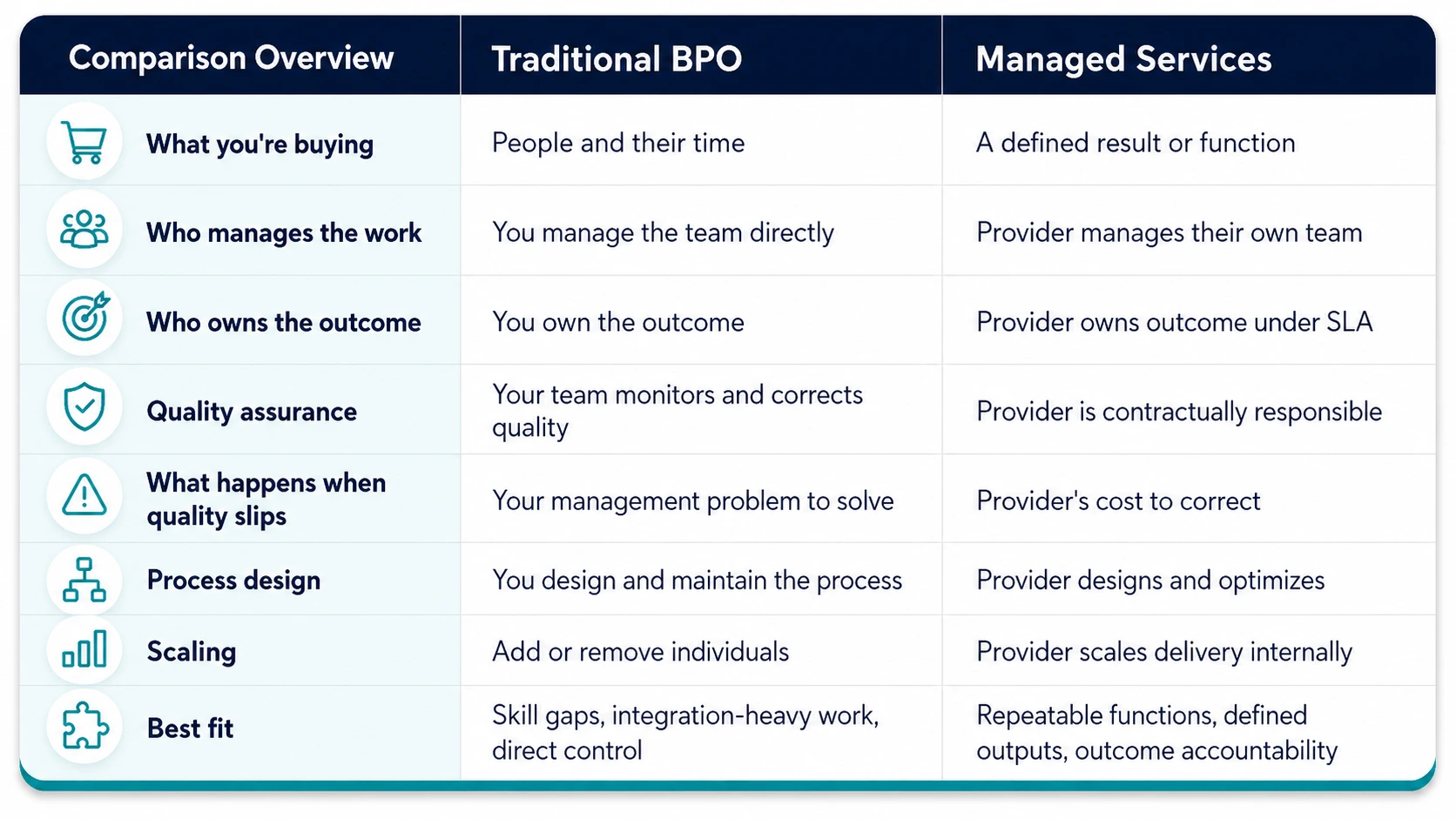
Business process outsourcing in its traditional form is a labor model. A provider sources, employs, and places people or teams to perform a defined set of tasks. The client tells those teams what to do, when to do it, and how to do it. The provider's obligation is to supply capable people who can execute the instructions. The accountability structure in traditional BPO is explicit: the provider delivers the headcount. The client delivers the outcome. If work quality is inconsistent, if the process design is wrong, if an exception isn't handled correctly, the client owns that problem. The provider fulfilled their obligation when they put qualified people in the roles.
This isn't a criticism of BPO as a model. It's an accurate description of what it is and what it commits to. For certain situations, that's exactly the right structure. The problem happens when organizations buy traditional BPO expecting managed services-level accountability, or when providers market BPO using managed services language without changing the underlying accountability structure.
What Managed Services Actually Means
Managed services is an outcome model. The provider takes ownership of a defined function or workflow and is contractually accountable for delivering a specified result, typically defined in an SLA that covers accuracy, turnaround time, and volume capacity. The accountability structure is inverted from traditional BPO. The provider owns the outcome. They determine how the work gets done, hire and manage the people who do it, design the process, maintain quality assurance, and correct errors at their own cost when they fall short of the agreed standard. The client manages a result, not a workforce.
This structure requires something BPO does not: a clear, specific definition of what the deliverable looks like before the engagement starts. You can't hold a provider accountable to an outcome you haven't defined. That upfront specification work is a prerequisite for managed services that isn't required in the same way for traditional BPO.
Side by Side: The Core Structural Differences
The Question That Reveals Which Model You Have
When something goes wrong in the engagement, whose first call is it to fix?
In traditional BPO, the answer is yours. The provider placed competent people. If the output is wrong, if the process produced an error, if a deadline slipped, the client's management team is the first line of response. The BPO provider may help, but the responsibility sits with the organization that owns the process. In managed services, the answer is the provider's. They committed to a standard. When they fall short of it, the SLA governs remediation. The provider corrects the issue, documents what happened, and absorbs the cost of making it right. The client reviews the correction, not the problem.
This isn't a subtle philosophical difference. It determines how you staff internally, how you structure vendor oversight, and what happens to your operation during the periods when the engagement is working imperfectly, which is most of the time in any real engagement.
Where Traditional BPO Still Makes Sense
The managed services model is not always the right choice, and being clear about when traditional BPO is the better fit saves a lot of friction.
Integration-heavy, judgment-intensive work: When a function requires deep familiarity with your internal systems, your specific business logic, or your institutional knowledge, having a provider team that integrates into your operation under your direction often works better than trying to hand off accountability for outcomes a provider can't fully control. Complex software development, strategic data analysis, and functions where context is everything tend to fit this profile.
Temporary capacity gaps: If you need additional capacity for a defined period (covering a leave, hitting a project deadline, bridging a hiring gap). Traditional BPO provides that flexibility cleanly. The engagement has a defined end point, you direct the work, and you scale back when the need passes. Managed services engagements are better suited to ongoing functions than temporary capacity needs.
When the process isn't documented yet: Managed services requires a clearly specified outcome before the engagement begins. If you haven't documented the process, can't define what good output looks like, or the function is still evolving, traditional BPO lets you maintain control while you figure that out. Some organizations use a BPO phase deliberately to build the process documentation they'll eventually hand to a managed services provider.
Where Managed Services Fits Better
Managed services makes the most sense in a specific set of conditions.
Repeatable, well-defined, high-volume functions
If a function follows predictable rules, produces measurable outputs, and runs at consistent volume, it's a natural candidate for outcome-based delivery. Document processing, reconciliation, compliance data aggregation, data entry workflows, and exception handling with defined escalation logic all tend to fit cleanly. The work can be specified clearly enough that a provider can own it end to end.
When internal management overhead has outgrown the value
If your team is spending significant time recruiting, training, supervising, and correcting work in a support function rather than doing the core work that drives the business, the overhead has outgrown the model. Converting that to a managed services relationship shifts the management burden to the provider and lets internal capacity return to higher-value work.
When consistency matters more than control
In regulated industries particularly, output quality needs to be consistent regardless of which individuals happen to be working on a given day. Traditional BPO quality varies with the people placed. A managed services provider is accountable for consistency as a contractual standard. For functions where quality directly affects compliance, financial accuracy, or customer experience, that accountability structure has real value.
The Evolution: Why the Market Is Shifting
Traditional BPO built its value proposition on labor cost arbitrage: access to lower-cost labor markets at a fraction of domestic headcount costs. That value proposition still exists but has eroded as labor costs in major outsourcing markets have risen and as automation has changed what requires a person at all. The more important shift is in what organizations are actually asking for. The demand is increasingly for outcomes, not effort. For accountability that survives employee turnover at the provider. For quality that doesn't depend on which individual is staffed to a project. For a cost structure that scales with volume rather than headcount.
That shift is what drives the BPO-to-managed-services evolution. Some traditional BPO providers have made the structural changes required to deliver managed services outcomes. Many have adopted the language without changing the accountability structure underneath it. The practical test is still the same: when something goes wrong, whose problem is it to fix?
HOW SHORE APPROACHES THIS
Shore Group evolved from a traditional offshore staffing and BPO operation into a managed services model specifically because the accountability gap in traditional BPO was the most common frustration among the clients we served. The elastic staffing model still exists for organizations that need skilled capacity they direct themselves. The managed solutions model takes end-to-end ownership of defined operational workflows with SLA-backed delivery for organizations that want to buy outcomes. Either path follows the same Pilot-to-Partnership model: discovery to map the function, proof of concept on real work, fixed-rate pilot, and long-term engagement only after results are confirmed. No commitment until you have seen the output.
What to Ask Before Signing Either Kind of Contract
The vendor proposal rarely makes the distinction obvious. A few questions that reveal the actual accountability structure underneath the terminology:
When quality falls below the agreed standard, what happens? Who is responsible for correction, and who pays for it?
Who designs and maintains the process? If requirements change, who bears the cost of adapting?
What does the SLA actually cover? Is it defined in terms of output quality and accuracy, or in terms of effort and availability?
What happens when a key individual on the provider's team leaves? How is continuity maintained?
What does the client need to manage day to day? If the answer involves significant oversight of the provider's team, the engagement is BPO regardless of how it's described.
The underlying question in both cases is whether you are buying people or buying results. A provider with a clear, direct answer to that question, backed by a contract that reflects it, is more trustworthy than one who hedges it with language about partnership and collaboration.
Frequently Asked Questions
Can a provider offer both traditional BPO and managed services?
Yes, and many do. Shore Group offers both. The important thing is clarity about which model applies to a specific engagement and ensuring the contract reflects that. A proposal that uses both sets of language without defining the accountability structure clearly is worth pressing on. You should know before signing exactly where accountability sits when something goes wrong.
Is managed services always more expensive than BPO?
Not necessarily, and comparing line-item costs directly is misleading. Traditional BPO has a lower visible cost per person but requires internal management overhead, onboarding investment, quality monitoring, and error correction. Managed services carries the provider's margin on top of their delivery cost, but removes those internal burdens. The total cost of ownership comparison depends on how expensive your internal management of the function actually is, which most organizations underestimate.
What's the difference between managed services and outsourcing generally?
Outsourcing is the broad category: any arrangement where a third party performs a function rather than internal staff. Managed services is a specific type of outsourcing characterized by outcome accountability, SLA governance, and provider ownership of the delivery process. Traditional BPO is also a form of outsourcing, but without the outcome accountability structure that defines managed services. The term outsourcing covers both.
How do you know if your current BPO arrangement could be converted to managed services?
The right questions to ask: Is the function repeatable and well-defined enough that you could specify what good output looks like in an SLA? Is there a provider with enough process expertise to own the outcome rather than just the labor? Has the internal management overhead on the current arrangement become a significant cost in its own right? If the answers are yes, the function is a candidate for converting to a managed services model.
Does managed services work for community banks given regulatory requirements?
Yes, and the regulatory environment is actually one of the strongest arguments for managed services at community banks. Examiners want to see documented processes, defined quality standards, clear accountability for data handling, and audit trails. A well-structured managed services arrangement produces all of those as a byproduct of normal operation. The key due diligence step is ensuring the provider has the compliance infrastructure to meet banking regulatory requirements: SOC 2 certification, documented data handling policies, and experience with the audit trail requirements specific to banking operations.
Not Sure Which Model Fits Your Operation?
Shore Group offers both elastic staffing and managed solutions, and can help you assess which structure makes sense before any commitment is made.
Learn More