
Business Process Outsourcing for Small Business: What Actually Works
Most BPO content is written for enterprises. Here is what outsourcing actually looks like for businesses under $50M — which functions work, which don't, and what the right engagement model is.
TL;DR
Most BPO content is written for enterprises. The minimums, the contract structures, and the management overhead assumptions do not apply to businesses under $50M. This post explains what BPO actually looks like at SMB scale: which functions work well, which do not, and what the right engagement model is when you need a two-person dedicated team rather than a 500-seat delivery center.
Sixty-three percent of small businesses are not yet outsourcing any functions. Among those that are, 48% list outsourcing more as a planned initiative for 2025-2026, according to a SCORE survey cited in a 2026 analysis by Stealth Agents. The gap between intent and action is not primarily about cost. It is about confusion: most of the outsourcing industry is built for enterprises, and the models, minimums, and contract structures that make sense at that scale do not transfer to a business with 20 employees and $15M in revenue.
The practical question for a small business COO or CEO is not whether outsourcing can work. The research is clear that it can. The question is which model fits, which functions are actually suitable, and what a well-structured engagement looks like when you do not have a procurement team and cannot absorb a 12-month contract for something that turns out not to work.
Why Most BPO Content Does Not Apply to Small Business
Enterprise BPO is structured around assumptions that do not hold at SMB scale. Large-scale BPO providers require minimum team sizes (typically 10-15 seats) that make no sense for a company that needs one or two people to handle a specific function. Onboarding timelines run 90-180 days for large contracts. Annual or multi-year commitments are standard. Program management overhead is built into the pricing model.
A small business evaluating outsourcing for the first time does not need any of that. It needs a single skilled professional who can be onboarded in two weeks, directed by the company's existing management, and scaled up or down as the function grows. The infrastructure around that person (HR, payroll, equipment, facilities) should be handled by the provider. Everything else should be within the client's control.
The reason many small businesses have a bad outsourcing experience is not that outsourcing does not work. It is that they engaged a model built for an organization ten times their size and found it did not fit.
What BPO Actually Means at SMB Scale
At small business scale, BPO is typically a dedicated professional or small team who integrates into the company's existing operations and handles a specific, well-defined set of tasks. They are not a call center. They are not a project-based contractor. They are a member of the operations team who happens to be employed by a third-party provider and works from a different location.
The provider handles all the employment logistics: hiring, onboarding, payroll, benefits, equipment, facilities management, and HR administration. The client handles everything related to the actual work: what gets done, in what sequence, to what standard, and to what output. The division is explicit, which is what makes the arrangement manageable for a small business that cannot devote significant management capacity to running a vendor relationship.
Functions That Work Well
Not every business function is suitable for outsourcing at SMB scale. The functions that work well share common characteristics: the process can be documented clearly, the output is measurable, volume is high enough to justify dedicated capacity, and the work does not require deep real-time institutional context that cannot be transferred.
Data operations and research
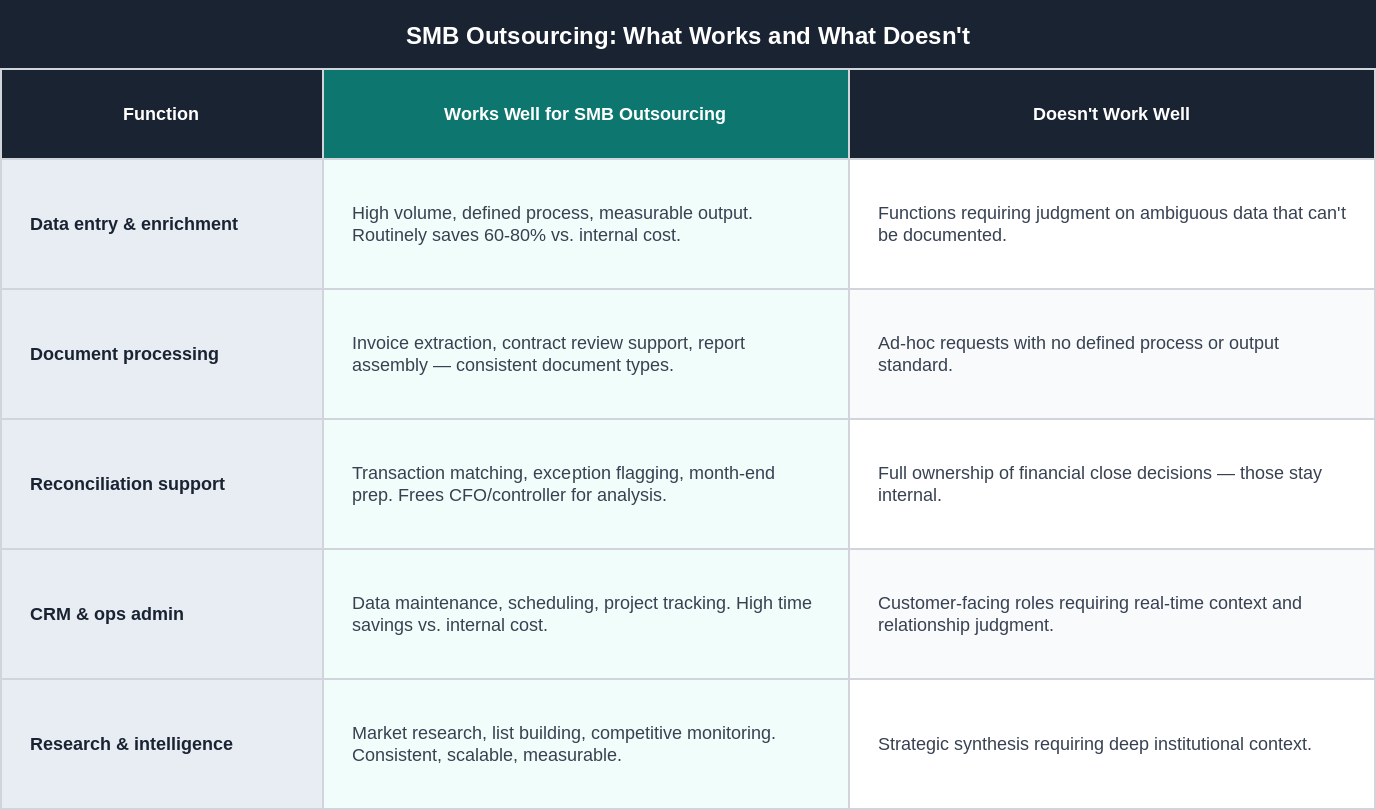
Data entry, data enrichment, list building, competitive research, and market intelligence are among the most commonly and successfully outsourced functions at SMB scale. The process is teachable in days, the output is measurable, and the work consumes significant internal time that tends to be done by people who should be doing something more valuable. A two-person offshore data team handling data entry and enrichment for a $20M B2B company typically costs less than one junior internal hire and can be scaled up or down based on project volume.
Document processing and review support
Invoice processing data extraction, contract review support, onboarding document handling, and report assembly work well when the document types are consistent enough to define a repeatable process. The key qualification is that these functions work best when the process design stays with the internal team and the outsourced professional executes against a defined workflow rather than making independent judgment calls about document handling.
Reconciliation and finance operations support
Transaction matching, exception identification, month-end close support, and reporting preparation are high-value targets for outsourcing when a small business has a controller or CFO who should be doing analysis but is spending time on data assembly. The outsourced function handles the mechanical preparation work. The internal professional handles the judgment and review. The division is clean and the time savings are immediate.
Operations coordination and administration
CRM data maintenance, project tracking updates, scheduling coordination, and back-office administrative work often consume disproportionate internal time relative to their strategic value. An offshore operations coordinator handling this category of work for a professional services firm or SaaS company typically frees up one to two hours per day of a senior internal person's time. At a company of 15-20 people, that is a meaningful capacity gain.
Functions That Do Not Work Well
Being honest about where outsourcing fails at SMB scale is as useful as describing where it works.
Functions requiring real-time judgment on ambiguous situations. A support function that regularly requires on-the-spot decisions about edge cases that are not covered by the documented process creates constant escalation back to internal management, which negates the capacity savings.
Customer-facing roles where communication nuance and cultural context are critical differentiators. This is less about geography and more about whether the role requires the kind of contextual judgment that is difficult to transfer through documentation.
Functions where the process changes frequently and documentation lags behind reality. An outsourced professional executing an outdated process is worse than no outsourcing at all.
Strategic and decision-making work. Outsourcing a function that should be internalized because it is core to the business model is a sign of a different problem that outsourcing will not solve.
What Works vs. What Doesn't: A Function Guide
The SMB-Specific Considerations
Several structural factors make the standard enterprise BPO model unsuitable for small businesses. Addressing them is the difference between an engagement that works and one that does not.
No minimum headcount requirements
Starting with one person and proving the model before scaling is the right approach for a small business. Providers that require minimum team sizes (typically 5-10 people to justify program overhead) are not appropriate for an initial SMB outsourcing engagement. The right starting point is a single dedicated professional, scaled only when the function is working and volume warrants it.
Month-to-month flexibility
Committing to an annual or multi-year contract for a function a small business is still figuring out is an unnecessary risk. The right model for initial SMB outsourcing engagements is monthly terms: the company pays for what it uses and can scale, adjust, or exit without a contractual dispute. Annual terms become appropriate after the engagement has proven itself and both parties have established confidence in the working relationship.
Transparent pricing
The elastic staffing model uses Cost+ pricing: the client sees exactly what the professional is paid, what the management fee covers, and what the overhead cost includes. There is no markup on labor, no rate card negotiation, and no hidden margin. This transparency matters at SMB scale because small businesses typically do not have procurement teams to audit vendor pricing. A clear cost structure removes that friction.
Direct management by the client
The client's management team should direct the daily work. The provider handles HR, payroll, facilities, and infrastructure. What the professional works on, in what sequence, to what standard, and in what tools is the client's responsibility. This division is important because it means the client retains process knowledge and is not dependent on the provider to understand how the work gets done.
Example: A $15M B2B SaaS Company
A $15M B2B SaaS company had two internal analysts spending approximately 60% of their time on data entry, list maintenance, and research tasks. The work was necessary but not strategic. Both analysts had been hired for roles that included analysis and customer data work, and the data entry portion had grown to consume most of their available time.
The company engaged a two-person offshore data operations team. Onboarding took three weeks: process documentation, tool access, a parallel run period, and gradual handoff. After six weeks, the offshore team was handling 100% of the data entry and list work. The internal analysts' time shifted almost entirely to analysis, reporting, and customer-facing data work.
The total cost of the offshore team was approximately 35% of what equivalent internal headcount would have cost. The internal analysts did not lose their jobs. Their jobs changed from operational to analytical. The company gained net analytical capacity without adding to headcount.
How to Evaluate Whether Your Business Is Ready
Three questions determine whether a function is ready for outsourcing at SMB scale.
Can you write down exactly what the person should do? If the process cannot be documented clearly enough that a new hire could follow it without constant clarification, the function is not ready. Process documentation is the work you do before outsourcing, not something the provider should figure out for you.
Is the volume high enough to justify dedicated capacity? A function that consumes three hours per week does not justify a dedicated full-time professional. A function that consumes 20+ hours per week is a candidate. The right minimum is roughly 60-70% of a full-time role to make a dedicated placement economical.
Can you measure the output? If you cannot define what success looks like (accuracy rate, volume per day, turnaround time), you cannot manage the engagement effectively. Outsourcing without output metrics is a recipe for a relationship that drifts toward failure without anyone noticing until a lot of time has been wasted.
Frequently Asked Questions
What is the minimum company size for outsourcing to make sense?
There is no firm minimum. A 10-person company with a high-volume data function that consumes 25 hours per week has a stronger outsourcing case than a 50-person company whose potential outsourcing candidate only needs 5 hours per week of dedicated effort. The driver is function volume and process definition, not company headcount. Most small businesses find that outsourcing becomes economical when the target function requires at least one full-time equivalent of dedicated work.
How long does it take to onboard an offshore professional?
For a well-documented function, two to three weeks is typical: one week for process documentation review and tool access, one week of parallel running where the professional works alongside the internal team, and one week of gradual handoff. For more complex functions with multiple process variants or specialized tool requirements, four to six weeks is more realistic. The biggest variable is documentation quality on the client's side. Providers cannot compress the onboarding timeline for a function the client has not yet documented.
How do we handle time zone differences?
Most SMB offshore outsourcing works on an overlap model rather than a follow-the-sun model. The offshore professional's working hours are shifted to overlap with several hours of the client's business day. For data and operations functions that do not require real-time collaboration, a 3-4 hour daily overlap is usually sufficient. For functions requiring more regular interaction, teams can be structured around larger overlap windows. The specific arrangement should be defined before the engagement begins, not worked out after the professional has started.
What happens to the engagement if our needs change?
The right engagement model at SMB scale is month-to-month, which means the client can scale the team up, scale it down, or end the engagement with appropriate notice. The process documentation and any tools or data owned by the client remain with the client regardless of how the engagement ends. A well-structured engagement agreement should specify that process documentation developed during the engagement belongs to the client, so there is no continuity risk if the relationship ends.
How is data security handled with an offshore team?
Data security for offshore engagements is an operational and contractual question, not an inherent risk of the model. The relevant controls include: access limited to the specific systems and data required for the function, use of the client's own tools rather than the provider's infrastructure for sensitive data, confidentiality agreements covering all team members, and clear data handling protocols documented in the engagement agreement. For regulated industries, additional controls may be required. The same due diligence you would apply to any third party with access to sensitive data applies here.
Built for SMB Scale, Not Enterprises
Shore Group's elastic staffing model is built for SMB scale. Month-to-month terms. Transparent Cost+ pricing. You share the process — we handle everything else.
See How Elastic Staffing Works