
How to Outsource Back-Office Operations Without Losing Control
The organizations that stay in control when they outsource define ownership clearly before any work changes hands. Here is the framework that makes that real.
TL;DR
The fear of losing control is the most common reason organizations delay outsourcing decisions that would clearly benefit them. In practice, organizations lose control not because outsourcing is inherently risky, but because they hand off work without establishing how oversight works. This post explains the specific ownership boundaries, SLA structures, documentation standards, and escalation mechanisms that keep an outsourcing engagement under genuine management control.
Every executive who has considered outsourcing a back-office function has had some version of the same concern: once the work leaves the building, how do we know it is being done right? How do we catch problems before they affect customers or regulators? And if something goes wrong, who is accountable?
These are the right questions. The problem is that most organizations ask them too late. They ask after the contract is signed, after the provider has started work, and after the accountability structure has already been implicitly established by whatever defaults the engagement agreement contained. By that point, gaining control requires renegotiating a relationship that has already started, which is substantially harder than building control into the structure from the beginning. The organizations that outsource successfully are not the ones with the most sophisticated vendor management programs. They are the ones that defined what control looks like before any work changed hands, and then built a simple operating structure around that definition.
A 2025 Collibra survey, cited in a 2026 outsourcing analysis by Auxis, found that fewer than half of technology leaders have formal governance frameworks in place for outsourced operations. That gap is exactly where control problems originate.
What Losing Control Actually Looks Like
Loss of control in an outsourcing engagement is rarely a single dramatic failure. It is usually a gradual drift that nobody notices until the accumulation becomes a problem.
Output quality drifts without a visible trigger:
The work meets the stated standard at the beginning of the engagement, then gradually falls short without any single event that would prompt a conversation. This happens when SLAs measure volume rather than quality, when quality sampling is infrequent, or when the client's internal team accepts substandard output rather than escalate. By the time the degradation is noticed, it has been running for weeks or months.
Process knowledge consolidates with the provider:
Over time, the institutional knowledge of how a function works (the edge cases, the exceptions, the rationale behind certain decisions) moves from the client's team to the provider's team. This is not inherently a problem. It becomes one when the provider's team turns over, when the provider is acquired, or when the client decides to bring the function back in-house. The client discovers they have lost the ability to manage the function because they have lost the knowledge of how it works.
Escalation paths become unclear:
When something goes wrong in an outsourced function, the client needs to be able to escalate quickly to someone with authority to fix it. In many outsourcing engagements, the escalation path is not clearly defined: the client emails a general account manager who routes the issue to an operations team who responds within a business day. When the issue is time-sensitive, that structure does not work.
Data access becomes asymmetric:
The provider sees the operational data for the client's function. The client sees a summary report once a week. When the client wants to investigate a specific output, they have to request data from the provider and wait. This asymmetry means the client's ability to monitor quality is limited by what the provider chooses to surface in the summary report. True oversight requires the ability to audit at the detail level on demand.
The Ownership Framework: What You Keep, What You Hand Off
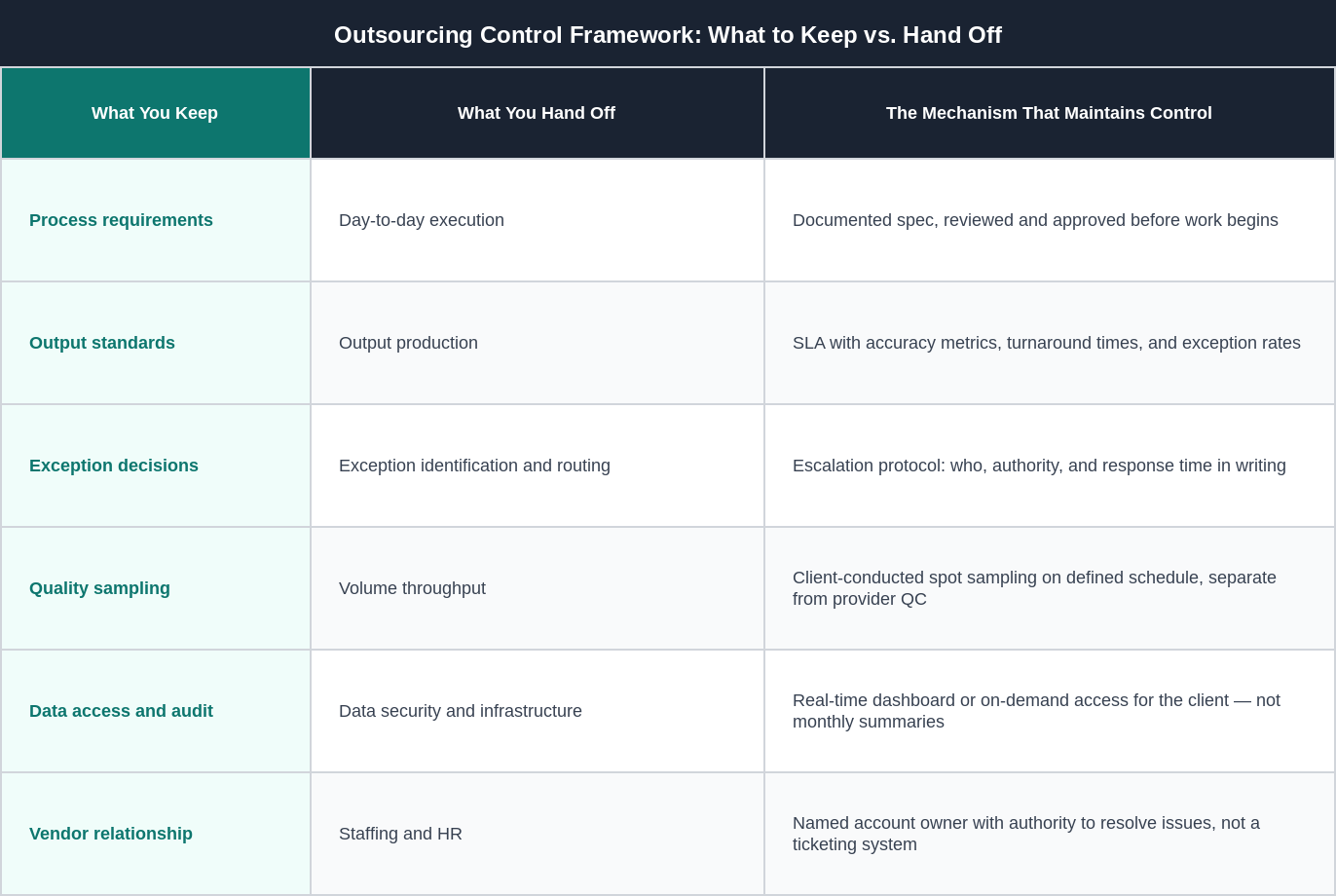
The Five Things to Define Before Any Work Begins
Most outsourcing governance problems can be traced to one of five things that were not defined before work started.
1. The process specification
The client's obligation before any handoff is a written process specification: what the function does, what inputs it receives, what the output looks like, how edge cases are handled, and what the acceptance criteria are for each output type. This document should be detailed enough that a professional hired tomorrow could execute the function to the required standard without asking the client for clarification on routine items.
This is the single most common shortcut that causes governance problems. Organizations hand off work before documenting it because documenting it is time-consuming. The result is that the provider learns the process by doing it, which means the process as documented in the provider's system may not match what the client actually intended.
2. The SLA structure
An SLA that measures the right things is the primary mechanism for maintaining output quality over time. Most back-office outsourcing SLAs measure volume and turnaround time because those are easy to measure. They often do not measure accuracy rate, exception rate, or rework rate because those require more work to define and track. The result is that the provider meets the SLA while the client's actual problem (the quality of the work) is not tracked at all.
A useful SLA for a back-office function typically includes: output accuracy rate (what percentage of outputs meet the defined standard on first delivery), exception rate (what percentage of items require human review), rework rate (what percentage of delivered outputs require correction after delivery), and turnaround time against volume benchmarks.
3. The escalation protocol
Define in writing: who the client contacts when something is wrong, what that person's authority is to resolve it, and what the response time commitment is. For operational issues (an output batch that failed, an exception queue that is aging), there should be a named individual the client can reach who can act. For relationship issues (declining quality that the account manager has not addressed), there should be a named individual at a different level for escalation.
Write this down before the engagement starts. The provider will have its own escalation structure. The client needs to know how to reach it.
4. The knowledge documentation requirement
Require the provider to maintain process documentation that lives with the client, not just within the provider's internal systems. This documentation should be updated whenever the process changes, should capture edge case decisions and their rationale, and should be accessible to the client on demand.
When the engagement ends, the client should be able to take that documentation and either bring the function in-house or move it to a different provider without losing the process knowledge built during the engagement.
5. The audit access requirement
The client should have the ability to review detail-level output data for any period, on demand, without requesting it from the provider. This does not mean the client needs to review everything. It means the client can investigate anything. If the only way the client can see this data is to ask the provider for it, the audit access is not real.
In practice, this means the provider's system should have a client-facing reporting interface that provides detail-level output records, exception logs, and quality metrics.
How to Evaluate an Engagement Before It Starts?
These questions should be answered before any outsourcing engagement begins.
What is the SLA structure, and does it include accuracy metrics, not just volume and turnaround time?
Who is the named account owner on the provider side, and what is their authority to resolve operational issues?
How does the client access output data for audit purposes — real-time or by request?
Where does process documentation live, and can the client access and retain it independent of the provider's systems?
What happens to institutional knowledge if the team members working on the engagement turn over?
What is the exit mechanism, and how long does a full transition take if the client decides to move the function elsewhere?
The Engagement Model Matters as Much as the Provider
How the engagement is structured has as much influence on the client's ability to maintain control as which provider they choose. The Outcome-as-a-Service model makes the accountability structure explicit: the provider commits to a defined output standard under an SLA, and when quality falls short, the correction is the provider's cost, not the client's management problem. The client does not manage the team. The client reviews the result and escalates when the standard is not met.
Contrast this with a traditional BPO structure where the client is effectively managing a remote team. The client directs daily work, handles training, maintains the process documentation, and absorbs all quality variance. The client has not outsourced the function. They have outsourced the employment of the people doing it while retaining all the management burden.
Shore's Pilot-to-Partnership model is designed specifically to let organizations test the governance structure before committing to a long-term engagement. The pilot period is not just a proof of concept for the work quality. It is a proof of concept for the oversight structure: does the SLA track what the client actually needs to track, does the escalation path work, does the audit access give the client the visibility they need?
Frequently Asked Questions
How much internal oversight time does managing an outsourcing engagement require?
For a well-structured engagement, the ongoing client oversight commitment is relatively low: reviewing the weekly quality summary (15-20 minutes), handling escalations when they occur (variable but infrequent in a well-functioning engagement), and conducting periodic process reviews (quarterly, 1-2 hours each). The daily execution management is the provider's responsibility. If managing the engagement requires more time than this on a routine basis, either the SLA is tracking the wrong metrics and creating manual investigation work, or the process specification was insufficiently detailed at the outset.
What do we do if quality declines after the engagement is running?
Quality decline in an outsourcing engagement is a process and documentation problem before it becomes a relationship problem. The first step is to identify whether the decline is across the board or concentrated in a specific process type or time period. If it is concentrated, there is usually a specific cause: a process not fully documented, a change in the input not reflected in the specification, or a team member transition without adequate knowledge transfer. If it is across the board, the SLA structure probably does not have enough measurement granularity to catch drift early, and the metrics need to be updated before the relationship conversation happens.
How do we handle a situation where the outsourced team turns over?
Staff turnover in an outsourcing engagement is the provider's HR problem to solve, but the client's knowledge continuity problem to manage. The mechanism that protects the client is process documentation that is current, accessible, and client-owned. When a new person joins the delivery team, they should be able to come up to speed from the documentation rather than from asking the departing team member. If the documentation is not current, the client should require an update before accepting any team change. This is a contractual right that should be written into the engagement agreement before the engagement starts.
Can we outsource a function we haven't fully documented ourselves?
Yes, but the documentation work has to happen before the handoff, not after. Most providers can assist with process documentation as part of the onboarding phase, typically through a discovery engagement where they map the current process by interviewing the internal team. The client should review and approve that documentation before work begins, because the provider's documentation of the process will become the specification the work is performed against.
What should the exit clause look like in an outsourcing agreement?
An exit clause should address three things: the notice period required to initiate a transition, the transition support the provider is obligated to provide (documentation handover, parallel running period, knowledge transfer sessions), and the ownership of any process documentation developed during the engagement. The process documentation should belong to the client. This is an important negotiating point before the engagement begins, not a question to address after the contract is signed.
Shore's engagement model is built around client control.
SLA-backed accuracy. Client-owned process documentation. Real-time visibility. You escalate when the standard is not met — we correct at our cost.
See How the Model Works