
What Is Outcome-as-a-Service? A Plain Language Guide
Software and staffing both leave you holding all the risk.
TL;DR
Every organization trying to scale its operations is sold two options: buy software you implement yourself, or hire people you manage yourself. In both cases, the client ends up as the systems integrator, owning all the risk when something goes wrong. Outcome-as-a-Service is a third model where the provider takes end-to-end ownership of a workflow and is contractually accountable for a defined result. This post explains what that means in practice, why it differs structurally from software and BPO, and what it looks like when it is working.
There is a question that comes up in almost every conversation about operations and technology: who is responsible when the result isn't what was promised?
With software, the vendor's answer is usually some variation of: we delivered the platform, implementation is your responsibility. With traditional BPO, the provider's answer is: we delivered the headcount, output quality is your responsibility. In both models, the client ends up managing the gap between what the tool or the team can do and what the business actually needs.
That accountability gap is not incidental. It is structural. It is built into how software licensing and staffing contracts are written. And it is the problem Outcome-as-a-Service was designed to solve.
According to a March 2026 analysis by Opsio citing IDC data, outcome-based outsourcing contracts grew from 22% of new deals in 2023 to 38% in 2025. The shift reflects a fundamental dissatisfaction with arrangements where vendors profit from time spent and clients absorb all delivery risk. The next question most organizations ask is: what does buying an outcome actually look like in practice?
The Two Options Most Organizations Are Sold
Before defining what Outcome-as-a-Service is, it helps to be precise about what the two traditional options are and where each one leaves the client.
The software option
Software vendors sell access to a platform. The platform is designed to help the client perform a function better, faster, or more accurately than they could without it. What the vendor does not provide is the work itself. The client implements the software, integrates it with existing systems, trains the team on it, configures it for their specific processes, and QCs the output it produces.
When the software doesn't produce the expected result, that is a client problem. The vendor fulfilled their obligation when they delivered a working platform. The gap between what the platform can do in general and what the client needs it to do in their specific environment is the client's implementation problem.
The staffing and BPO option
Traditional BPO and offshore staffing solve a different constraint: not enough people to do the work. The provider sources, employs, and places professionals who execute tasks under the client's direction. The provider's obligation is to supply capable people. The client's obligation is to manage those people, maintain the process design, QC the output, and handle everything that goes wrong.
When output quality slips, that is also a client problem. The BPO provider delivered the headcount. What the team produces with that headcount, and whether it meets the client's standards, is the client's management problem.
What Both Models Have in Common
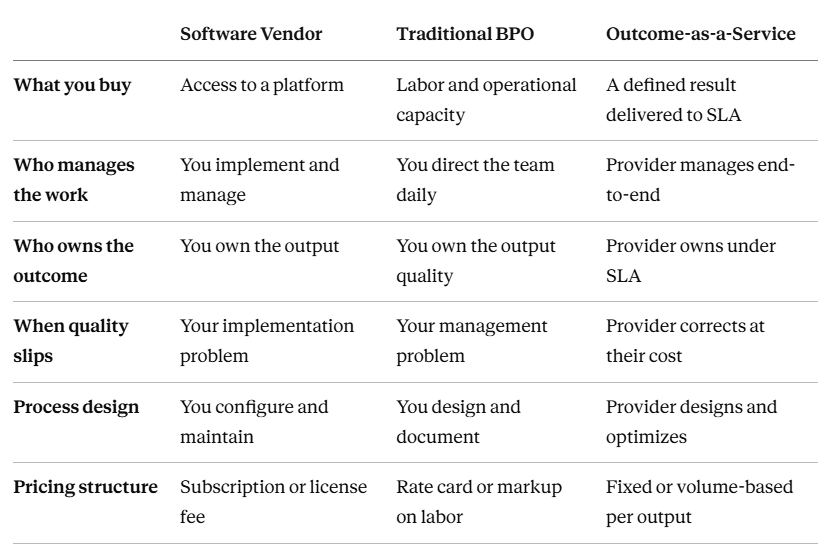
The structural similarity between software and BPO is easy to miss because they look completely different on the surface. One sells technology. The other sells people. But both models share the same accountability architecture: the vendor delivers an input, and the client owns the output. The client is always the systems integrator. The client is always the one who fills the gap between what the vendor provides and what the business actually needs. When the output falls short of expectations, the question of whose problem it is always resolves to the client.
This is not a criticism of software vendors or BPO providers. It is an accurate description of how those contracts are structured. The problem is that this structure is often invisible until something goes wrong.
Example: A community bank buys a loan document processing platform. The platform extracts data from PDFs. The bank's team still has to validate the extractions, handle formats the platform can't process, correct errors before they reach the LOS, and manage the workflow around the tool. When the underwriting team gets bad data, nobody calls the software vendor. The bank's operations team fixes it. The same bank then hires a BPO team to handle document prep. While the team does the work, the bank's management team still has to train them, QC their output, fix the process when exceptions occur, and manage the relationship when someone leaves. The BPO fulfilled its obligation. The bank absorbed the rest.
What Outcome-as-a-Service Means
Outcome-as-a-Service inverts the accountability structure. Instead of the provider delivering an input and the client owning the output, the provider takes end-to-end ownership of a workflow and is contractually accountable for a defined result.
The deliverable is not a platform. The deliverable is not headcount. The deliverable is a specific, measurable output: clean loan data extracted from documents and delivered in LOS-ready format. Same-day reconciliation with exceptions routed and resolved. Compliance data aggregated, validated, and formatted for regulatory submission. The provider owns the accuracy and timeliness of that output under a service level agreement. The client reviews a result.
Accountability is inverted
When quality falls short in an OaaS engagement, it is the provider's cost to fix. Not the client's management problem. Not a gap that falls between the software and the implementation. The provider committed to a standard. When they fall short, they correct it at their expense and document the correction. The client escalates. The provider resolves.
Pricing follows results, not inputs
OaaS pricing is tied to the delivery of the defined output, not to the time spent or the number of people deployed. This is not a subscription to a tool. It is not a rate card for offshore analysts. It is a fixed or volume-based price for a defined data product, delivered to a defined standard, on a defined schedule.
The provider designs and maintains the process
In traditional BPO, the client owns the process documentation and the workflow design. In OaaS, the provider owns both. They decide how to ingest the data, how to process it, how to handle exceptions, and how to deliver the output. The client defines requirements. The provider determines execution. This is the source of the accountability: you cannot hold a provider responsible for outcomes they don't control.
Expertise is embedded in delivery
Because the provider owns the process, they are motivated to make it work efficiently. There is no incentive to deploy more people than necessary or to allow quality to drift. The provider's margin depends on delivering the defined result at a cost they manage. This structural alignment produces consistently better outcomes than arrangements where the provider profits from volume or hours regardless of quality.
The Three-Way Comparison
When OaaS Is the Right Choice
Not every function suits the OaaS model. Some work genuinely requires direct client management: judgment-intensive roles, deep institutional context that cannot be transferred, and functions where the client needs real-time control of individual decisions. Recognizing that helps clarify where OaaS actually fits.
High-volume, repeatable, well-defined functions
If a function follows predictable rules, produces a measurable output, and runs at consistent volume, it can be specified clearly enough for a provider to own it end to end. Document processing, reconciliation, compliance data aggregation, data entry and validation, and exception handling with defined escalation logic all tend to fit this profile. The work can be documented with enough precision that the provider can own the result.
When internal management overhead has outgrown the value
If a significant share of management time is going to recruiting, training, supervising, and correcting output in a support function rather than to the core work that drives the business, the overhead has outgrown the model. Converting that function to an OaaS arrangement shifts the management burden to the provider and returns internal capacity to higher-value work.
When consistency matters more than direct control
In regulated industries particularly, output quality needs to be consistent regardless of which individuals happen to be working on a given day. An OaaS provider is accountable for that consistency as a contractual standard. For functions where quality directly affects compliance, financial accuracy, or customer experience, that accountability structure has measurable value.
When the priority is results before commitment
Organizations that are uncertain whether a provider can actually deliver what they promise benefit from a model that proves value before requiring commitment. Shore's Pilot-to-Partnership model is structured specifically for this: Discovery to map the function, POC on real data, a fixed-rate Pilot before any long-term engagement, and Partnership only after the client has seen the output they're buying.
What OaaS Does Not Eliminate
Being clear about what the model does not do matters as much as describing what it does.
OaaS does not eliminate the client's need to define requirements. The provider can only own the outcome of a workflow the client has defined. Vague requirements produce vague results.
OaaS does not remove the client's oversight responsibility. The client still reviews results, escalates when standards are not met, and maintains the relationship. What it removes is day-to-day execution management.
OaaS does not work for every function. Highly variable, judgment-intensive, or strategically sensitive work is not a candidate. The model requires a function stable and well-defined enough that a provider can commit to delivering it.
OaaS is not a hands-off arrangement. The best OaaS engagements are collaborative. The provider brings process expertise and delivery accountability. The client brings context, requirements clarity, and feedback on output quality.
How Shore Applies This Model
Shore Group operates as an Outcome-as-a-Service provider across document intelligence, data operations, reconciliation, compliance data aggregation, and back-office workflow management. The delivery model combines automation with a human-in-the-loop quality layer, producing SLA-backed accuracy on workflows that no fully automated system can guarantee alone. For context on how this differs structurally from BPO vs. managed services more broadly, that distinction is covered in detail on the blog.
The engagement model is designed to reduce commitment risk. Every new engagement starts with a free Discovery conversation to map the function and define requirements. That leads to a low-cost POC on the client's actual data. Then a fixed-rate Pilot where the workflow runs in a limited production setting. Only then does the client decide whether to expand into a full Partnership, with month-to-month terms and no lock-in.
The intent is that by the time a client makes a significant commitment, they are not buying a promise. They have already seen the output.
Frequently Asked Questions
Is Outcome-as-a-Service the same as managed services?
There is significant overlap, but managed services is a broader category. Some managed services arrangements transfer outcome accountability fully to the provider. Those fit the OaaS definition. Others are closer to traditional BPO with a managed services label: the provider supplies a team and a process, but the client still owns quality and escalation. The differentiating question is: when quality falls short, whose first call is it to fix? If the provider owns that, it is OaaS. If the client owns it, it is closer to managed staffing.
How is OaaS different from SaaS?
SaaS sells access to software. The client performs the work using the software. OaaS sells the work itself. The provider uses whatever combination of technology and expertise is required to deliver the defined output. The client never manages the tool or the team that runs it. They consume a result. The distinction matters most when something goes wrong: a SaaS vendor is responsible for the platform working as documented, not for the output the client produces with it.
What happens when the provider misses the SLA?
A well-structured OaaS contract defines remediation requirements when the SLA is missed: the provider corrects the output, documents what happened, and in some cases absorbs financial penalties. The client should not need to rebuild the output themselves or absorb the error downstream. The SLA is the mechanism that makes the accountability structure real rather than aspirational.
What kinds of workflows suit the OaaS model?
The best candidates share three characteristics: high volume, predictable rules, and a measurable output. Document processing, transaction reconciliation, compliance data aggregation, data entry and validation, and exception handling with defined escalation criteria all tend to fit. Functions requiring real-time judgment, deep institutional context that cannot be documented, or strategic decision-making are generally better served by internal teams or direct-managed staffing arrangements.
How does pricing work in an OaaS model?
OaaS pricing is typically fixed per period or variable per unit of output rather than based on hours or headcount. A fixed monthly fee for a defined workflow is common for stable volumes. Volume-based pricing — per document processed, per transaction reconciled, per record delivered — suits functions where volume fluctuates. In both cases, the price is tied to the delivery of the output, not to the inputs the provider deploys to produce it.
Ready to Transform Your Operations?
Discovery is free. The POC runs on your actual data. You commit only after you have seen the output.