
Staff Augmentation vs. Managed Services
How to Know Which One Your Business Actually Needs
TL;DR
Staff augmentation and managed services are both legitimate ways to bring outside capability into your organization, but they solve different problems and put accountability in different places. Staff augmentation gives you people your team manages. Managed services give you an outcome a provider is accountable for. Choosing the wrong model for the wrong situation creates friction that shows up later as management overhead, quality problems, or cost surprises. This post explains the structural difference between the two models, when each one makes sense, and where the hidden costs live in both.
Most companies reach a point where internal headcount can't keep up with operational demand. A project needs skills the team doesn't have. A process is consuming more time than the people handling it can reasonably absorb. A function needs to run reliably while the core team focuses elsewhere. The response is usually one of two things: find people to add to the team, or find a provider to take ownership of the function. Both are reasonable answers. They are not the same answer.
Staff augmentation and managed services get used interchangeably in vendor pitches and procurement conversations, but they operate on fundamentally different principles. One is a labor model. The other is an outcome model. Treating them as equivalent, or choosing between them without understanding the structural difference, tends to produce frustrating results regardless of which direction you go.
Here is what distinguishes them, when each model fits, and what the costs look like in practice.
What Staff Augmentation Actually Means
Staff augmentation is the practice of adding external individuals to your team to fill a capacity or skill gap. The augmented staff work alongside your employees, typically follow your processes, report into your management structure, and operate as extensions of your internal team. You are buying people. The provider sources, vets, and sometimes employs them. But once they are working on your project or process, the day-to-day direction, quality oversight, and outcome accountability sit with you.
The model is well-suited for situations where:
You have a specific skill gap your existing team doesn't cover
You need temporary capacity for a defined project or peak period
You want to maintain direct control over how the work gets done
The work requires close integration with internal processes or systems that only your team fully understands
The IT staff augmentation market reflects how common this need is. According to a January 2026 analysis by Mismo, the global staff augmentation market is projected to reach nearly $12 billion by 2032, driven largely by companies seeking flexible access to specialized skills without committing to full-time headcount.
Source: Staff Augmentation vs. Managed Services: Key Differences
Mismo, January 2026
What the market size doesn't capture is the management overhead that comes with the model. When you augment with staff, you are not offloading a function. You are adding capacity to a function you still own and operate.
What Managed Services Actually Means
Managed services is a different structure entirely. Instead of placing people into your team, a provider takes ownership of a defined function or workflow and is accountable for delivering a specified outcome. You define what needs to happen. They determine how to make it happen, staff it, manage it, and guarantee the result under a Service Level Agreement.
The key distinction: you are not managing individuals. You are managing a result. In a well-structured managed services arrangement, the provider handles:
Staffing and managing the people who do the work
Designing and maintaining the process that produces the output
Quality assurance and error correction
Scaling capacity up or down as volume changes
Reporting on performance against agreed SLAs
The operational burden on your team is limited to defining the requirement clearly, reviewing output, and managing the vendor relationship at a strategic level. The day-to-day execution is theirs. This model fits situations where the function is well-defined, the outcomes are measurable, and your organization is more interested in reliable results than in controlling how the work gets done.
Side-by-Side: The Core Differences
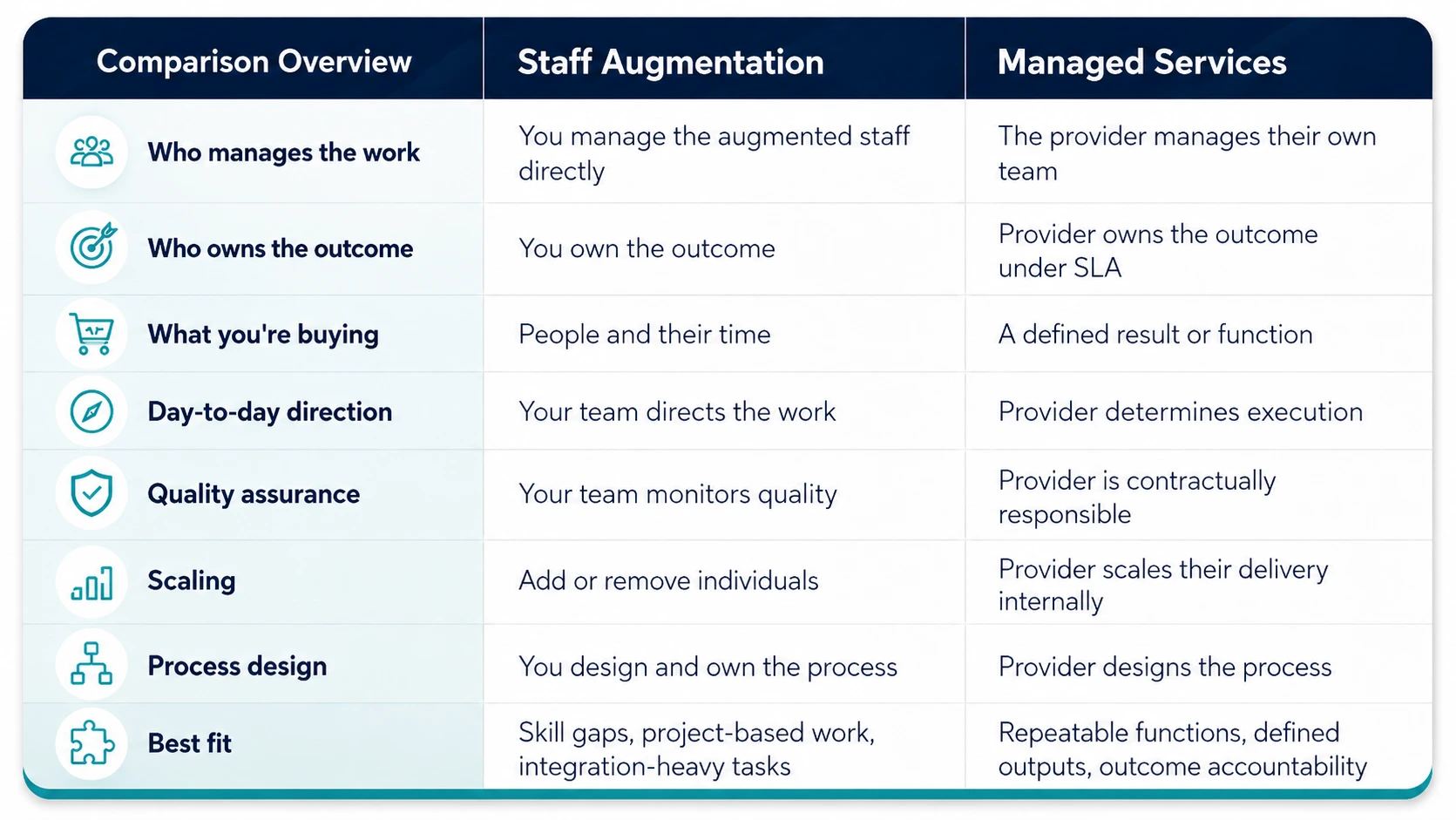
The Core Difference: Who Owns the Outcome
Everything else in the comparison flows from one structural question: when something goes wrong, whose problem is it?
In a staff augmentation arrangement, the answer is yours. The provider placed a qualified person. If the output isn't right, if the process breaks, if quality slips during a transition period, your team absorbs that. The provider fulfilled their obligation when they delivered the resource. In a managed services arrangement, the answer is the provider's. They committed to an outcome. If quality falls below the agreed standard, they are responsible for correcting it at their own cost. The SLA exists precisely to define what accountability looks like.
This isn't a value judgment about either model. It's a description of where risk sits. Staff augmentation gives you control and puts risk on you. Managed services transfers risk to the provider and reduces your control over execution. Neither is inherently better. The question is which risk profile and control level matches what you actually need for a given function.
When Staff Augmentation Makes Sense
Staff augmentation works well in a few specific scenarios.
#1 Complex, integration-heavy projects
When work requires deep knowledge of your internal systems, architecture, or business logic, an external person who integrates into your team is often more effective than a provider trying to deliver an outcome from a distance. Software development projects, data engineering work that touches proprietary infrastructure, and strategic analysis that requires institutional context tend to fit this profile.
#2 Short-term skill coverage
If you need a specific capability for a defined period (to cover a parental leave, hit a project deadline, or bridge a hiring gap) staff augmentation provides that flexibility without a long-term commitment. You scale up when you need it and scale back when the need passes.
#3 When you want to learn before you commit
Augmenting with external staff on a function you're considering outsourcing is a reasonable way to understand the work before you hand it to a managed services provider. You retain oversight while building the documentation and process clarity that makes a managed handoff viable later.
When Managed Services Makes Sense
Managed services fits a different set of conditions.
Repeatable, well-defined functions
If a function follows predictable rules, produces measurable outputs, and doesn't require deep integration with your internal decision-making, it's a candidate for managed delivery. Document processing, reconciliation, data entry, compliance data aggregation, and similar back-office operations tend to fit cleanly here. The process can be specified clearly enough that a provider can own it end-to-end.
When the management overhead of staff has become the problem
If your team is spending significant time recruiting, onboarding, training, and managing staff in a support function rather than doing the core work that drives your business, the overhead has outgrown the model. Managed services converts that management burden into a vendor relationship with defined performance expectations.
When quality consistency matters more than cost
Staff augmentation quality varies with the individuals placed. A strong hire produces good results. A weaker one requires more oversight. A managed services provider is responsible for consistency regardless of who is doing the work on their end. For functions where output quality directly affects compliance, customer experience, or financial accuracy, that accountability structure has real value.
When you need to scale without headcount decisions
If a function needs to process twice the volume next quarter, staff augmentation requires sourcing twice the people. Managed services providers are contractually obligated to deliver the agreed volume at the agreed quality level, however they need to staff it. For organizations with variable or growing operational demand, that flexibility removes a category of planning friction.
The Hidden Costs in Both Models
Neither model is as straightforward as it looks in a vendor proposal. Both carry costs that don't appear on the contract.
Hidden costs in staff augmentation:
Management time: augmented staff require direction, feedback, onboarding, and oversight that consumes manager and senior employee capacity, often more than anticipated
Ramp time: external staff working in your environment take weeks or months to reach full productivity, during which output is lower and error rates are higher
Knowledge transfer: when augmented staff rotate off, institutional knowledge leaves with them unless your team actively documents and maintains it
Integration friction: the more your process depends on internal context, the longer it takes for external staff to operate independently
Hidden costs in managed services:
Specification effort upfront: managed services requires you to define the outcome clearly before the engagement starts. If the requirements are vague, the output will be too
Vendor management overhead: even with outcome accountability on the provider's side, someone on your team has to manage the relationship, review performance data, and handle escalations
Transition costs: moving a function to a managed services provider requires process documentation, knowledge transfer, and a testing period that takes time and internal resources
Loss of flexibility: managed services works best for stable, well-defined functions; if the requirements change frequently, renegotiating scope adds friction
A Third Option: Starting with One and Evolving to the Other
The choice between staff augmentation and managed services isn't always permanent. For many organizations, the practical path starts with one model and moves toward the other as the function matures.
A common pattern: a company augments with staff on a back-office function to understand it better, documents the process while those staff are running it, and then transitions to a managed services arrangement once the requirements are clear enough to specify in an SLA. The augmentation phase builds the institutional knowledge the managed services provider needs to take ownership. The reverse also happens: a company that has used managed services for a function decides it needs more control over a specific component, brings in augmented staff to run that piece, and maintains managed delivery for the rest.
Shore Approaches This Differently:
Shore Group offers both models under one engagement structure. Our elastic staffing model extends your team with skilled professionals you direct. The managed solutions model takes end-to-end ownership of defined operational workflows with SLA-backed delivery. Many clients start with one and migrate to the other as confidence builds. Either path follows the same Pilot-to-Partnership model: a discovery session to map the function, a proof of concept on real work, a fixed-rate pilot to validate the output, and a long-term engagement only after results are confirmed. No long-term commitment until you've seen it work.
How to Evaluate Providers for Either Model
The questions worth asking differ depending on which model you're evaluating.
For staff augmentation providers
How do you source and vet the individuals you place? What does the screening process look like for the specific skills we need?
What happens if the person placed isn't a fit? What's the replacement process and timeline?
Who is the employment relationship with, and what does that mean for our liability and compliance obligations?
What's the notice period if we need to scale down or end the engagement?
For managed services providers
How is the SLA structured, and what are the penalties or remedies if performance falls below the agreed standard?
How do you handle exceptions, errors, and edge cases that fall outside the defined process?
What does the transition and onboarding process look like, and what do you need from us to make it work?
Can we see examples of how you've managed scope changes or requirement evolution in similar engagements?
What does day-to-day reporting look like, and how do we escalate issues?
The underlying question in both cases is the same: how does accountability work when something goes wrong? A provider with a clear, confident answer to that question in either model is more trustworthy than one who hedges it
Frequently Asked Questions
Can the same provider offer both staff augmentation and managed services?
Yes, and many do. The key is understanding which model applies to which engagement and ensuring the contract reflects that clearly. A provider offering both models isn't inherently a problem, but a proposal that blurs the line between the two often is. You should know exactly where accountability sits before the engagement starts.
Is managed services always more expensive than staff augmentation?
Not necessarily, and comparing costs at face value is misleading. Staff augmentation has a lower line-item cost but requires management overhead, onboarding investment, and quality oversight from your team. Managed services carries the provider's margin on top of labor costs, but removes those internal burdens. The total cost of ownership comparison depends on how expensive the management burden is for your organization and how much you value outcome certainty.
What's the difference between managed services and outsourcing?
Outsourcing is the broader category: any arrangement where a function is performed by an external party rather than internal staff. Managed services is a specific type of outsourcing characterized by outcome accountability, SLA governance, and provider ownership of the delivery process. Traditional BPO arrangements often lack the SLA structure and outcome accountability that define managed services, even though they involve external delivery.
How long does it typically take to transition a function to managed services?
The honest answer depends on how well-documented the function is before the transition begins. A process with clear requirements, documented exceptions, and measurable outputs can transition in four to eight weeks. A function that has never been formally documented, where the process lives in the heads of the people currently doing it, takes longer because documentation has to happen first. Most managed services transitions involve a parallel-run period where both the existing process and the new delivery run simultaneously before full handoff.
Is staff augmentation the same as contract staffing or temp-to-perm hiring?
Not exactly. Contract staffing and temp-to-perm arrangements are typically sourced through traditional staffing agencies and may have a different end state in mind (permanent hire). Staff augmentation, in its current usage, usually refers to external professionals who remain employees of the provider throughout the engagement, with no expectation of permanent placement. The distinction matters for liability, benefits, and how the relationship is managed.
NOT SURE WHICH MODEL FITS YOUR SITUATION?
The right answer depends on the specific function, how clearly the requirements can be defined, and how much management bandwidth your team has to direct external staff. Shore Group offers both models and can help you think through which structure fits before any commitment is made.
Start with a Discovery Call