
Digital Asset Governance for Community Banks: The Six Areas Every Framework Must Cover
Whether your bank engages with digital assets or not, six governance areas need to be addressed before any board makes a well-governed decision. Part 2 of 3.
PART 2 OF 3: DIGITAL ASSET GOVERNANCE FOR COMMUNITY BANKS:
Part 1 of this series covered why community banks need a digital asset position now, with the GENIUS Act in law and bank-built tokenized deposit infrastructure live on Ethereum. This post covers what a governance framework for digital assets actually needs to contain.
TL;DR
A digital asset governance framework is not a document you file and forget. It is the operating structure that allows a community bank to make, monitor, and defend any decision it takes regarding digital assets, including the decision not to engage. Six areas need to be addressed: strategic authorization, custody and key management, reserve and liquidity oversight, BSA/AML and sanctions compliance, data lineage and audit trail, and vendor and third-party oversight. This post explains what each area covers, who should own it, and what examiners are most likely to probe in each.
The Wolters Kluwer's recent analysis of the GENIUS Act's implications for US banks identified five internal functions that must engage before a bank can safely participate in digital assets: strategy, risk management, compliance, technology, and treasury. That framing is useful for large banks with dedicated teams in each of those functions, but community banks typically do not have that organizational structure, which means the governance design has to be proportionate to the institution.
Proportionate does not mean minimal. It means the governance structure fits the bank's size, complexity, and actual digital asset activity. A community bank that has not yet made any digital asset decisions still has governance obligations: the framework needs to exist before the decisions arrive, not as a response to them. And a community bank that has vendor-embedded digital asset capabilities operating in its BSA/AML or payment systems today already has digital asset exposure that requires oversight, regardless of whether the bank has formally designated digital assets as a strategic priority.
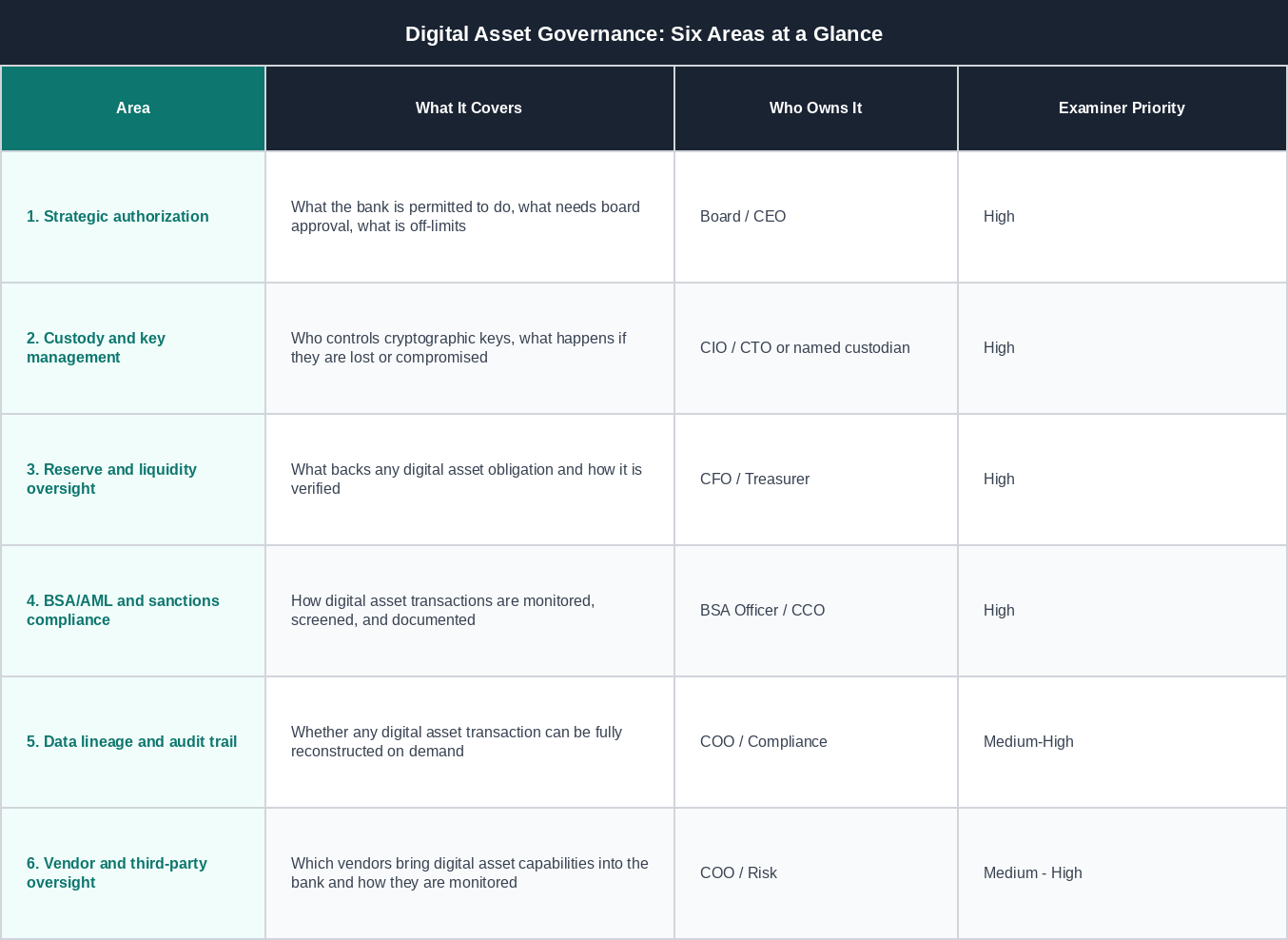
The six areas below are drawn from the GENIUS Act's requirements, the OCC's proposed implementing rules, the FDIC's December 2025 proposed rulemaking on stablecoin issuance through bank subsidiaries, and general safety and soundness expectations. They apply at different levels of intensity depending on how engaged a bank is with digital assets.
The Six Areas at a Glance
Area 1: Strategic Authorization
The first governance question is the most foundational: what is this bank permitted to do with digital assets, and who has authority to change that? Without a defined scope, every other governance element is incomplete. You cannot govern what you have not defined.
What this area covers
Strategic authorization is the documented set of boundaries within which the bank may engage with digital assets. It answers three questions explicitly. What activities are permitted: accepting digital asset deposits, offering custody services, participating in a tokenized deposit consortium, investing in digital asset securities, or using digital assets as payment settlement infrastructure. What activities require board approval before the bank may proceed. And what activities are explicitly prohibited regardless of opportunity.
Authorization is not the same as strategy. A bank can have a strategic posture of "monitor and do not engage" and still document it as an authorization boundary. That document tells the board, the management team, and the examiner that the bank has thought through its position rather than simply having no position.
Who owns it
The board defines the authorization boundaries. Management implements them and brings proposed changes to the board for approval. In practice, the CEO or CCO typically drafts the initial authorization language and presents it for board adoption. Once adopted, the authorization document should appear in board meeting minutes and be reviewed annually, or whenever a material change in the digital asset landscape warrants reconsideration.
What examiners look for
Examiners are increasingly asking management teams to articulate the bank's digital asset posture in examination conversations. A bank that can point to a board-adopted authorization document is in a fundamentally different position than one that says "we haven't really discussed it." The absence of a documented position is not neutral. It signals that the bank's governance structure has not yet caught up with the environment the bank is operating in.
Area 2: Custody and Key Management
Custody is the area most community banks underestimate when they begin thinking about digital asset governance. In traditional finance, custody refers to the safekeeping of securities and cash. In digital assets, custody means control of the cryptographic private keys that authorize transactions. Whoever controls the keys controls the assets. There are no overrides, no reversals, and no customer service numbers for lost keys.
What this area covers
Custody governance for a community bank addresses three questions. First, who holds the private keys for any digital asset account the bank operates or administers, and under what institutional controls? Second, what happens if those keys are lost, compromised, or if the key holder leaves the bank or becomes unavailable? Third, how does the bank verify that custody arrangements with third-party providers are functioning as described?
For community banks participating in a consortium like the Hazel Network, custody of the on-chain signing keys is handled by Custodia as the technology provider. This reduces the bank's direct custody burden but does not eliminate the oversight obligation. The bank still needs to understand what custody arrangement exists, how it is governed, and what recourse exists if something goes wrong with the custodian.
Who owns it
For banks handling custody directly, the CIO or CTO owns the technical key management controls. For banks using third-party custodians, the Chief Risk Officer or COO owns the vendor oversight relationship. In either case, the board should receive an annual report confirming that custody arrangements are documented, current, and subject to independent review.
What examiners look for
The OCC's proposed GENIUS Act implementing rules include specific standards for custody and safekeeping of reserve assets. The FDIC's December 2025 proposed rulemaking on stablecoin subsidiary applications required detailed information on governance and control arrangements as part of the application. Examiners will ask who holds the keys, under what controls, and how the bank knows the arrangement is working. A bank that cannot answer these questions specifically has a custody governance gap regardless of whether the digital asset activity is conducted directly or through a vendor.
Area 3: Reserve and Liquidity Oversight
The GENIUS Act's most concrete operational requirement for stablecoin issuers is the one-to-one reserve mandate: every payment stablecoin outstanding must be backed by an equivalent amount of cash or short-duration Treasury instruments held in segregated reserves. Monthly disclosure, examined by a registered public accounting firm, is required. For community banks that participate in a consortium where a partner entity is the stablecoin issuer, reserve oversight is a primary governance obligation even when the bank is not itself holding the reserves.
What this area covers
Reserve governance at a community bank addresses what backs any digital asset obligation the bank has accepted or guaranteed, how that backing is verified on an ongoing basis, and who at the bank reviews the verification. For consortium participants, this means understanding the reserve architecture: where the reserves are held, under whose custodianship, what the attestation schedule is, and what rights the member bank has to independently verify the reserve state.
The Hazel Network white paper addresses this directly: the programmatic reserve balance is enforced on-chain by the smart contract itself, and every out-of-consortium transfer checks external supply against the declared reserve before settling. Monthly attestation by a PCAOB-registered auditor confirms the declared reserve matches actual segregated reserves. For a member bank, reviewing these attestations and understanding the on-chain verification mechanism is the reserve governance obligation.
Liquidity considerations
Stablecoin-related projects introduce liquidity considerations that are distinct from traditional deposit management. Run risk (the possibility of rapid, large-scale redemption demand) is a known feature of stablecoin instruments. A community bank participating in digital asset infrastructure needs a liquidity analysis that specifically addresses what happens if redemption demand spikes and how the bank's existing liquidity position interacts with its digital asset obligations.
Who owns it
The CFO or Treasurer owns reserve and liquidity oversight. This includes reviewing reserve attestations, maintaining the liquidity analysis, and reporting to the board on the bank's digital asset-related liquidity position.
Area 4: BSA/AML and Sanctions Compliance
Treasury's September 2025 proposed rulemaking on BSA/AML obligations for payment stablecoin issuers sent a clear signal: digital asset compliance is not a lighter-touch regime. The same Bank Secrecy Act obligations that apply to traditional banking activity apply to digital asset activity. Customer identification programs, suspicious activity reporting, OFAC screening, and AML monitoring are all required, applied to a transaction type that operates 24/7 across a permissionless global network.
What this area covers
BSA/AML governance for digital assets covers five specific obligations. Customer identification for any digital asset account holder, including beneficial ownership for entities. On-chain wallet screening against OFAC sanctions lists and law enforcement designations. Transaction monitoring calibrated to digital asset typologies: structuring, mixing, rapid layering across multiple wallets, and patterns associated with ransomware or darknet marketplace activity. SAR filing for digital asset activity that meets the reporting threshold. And record-keeping that satisfies BSA's five-year retention requirement. For a detailed treatment of how automated BSA/AML workflows apply to community banks, see the post on BSA/AML compliance.
The Hazel Network addresses BSA/AML compliance structurally through a three-layer screening pipeline: fiat-side AML and sanctions checks at initiation, blockchain analytics screening on wallet addresses before execution, and an on-chain sanctions oracle check embedded in the smart contract itself. For member banks, this reduces the transaction-level screening burden but does not eliminate the bank's own BSA compliance obligations.
The digital asset-specific challenge
Digital asset transactions are pseudonymous by design. A wallet address is not a name. Linking customer identities and accounts to on-chain wallets, and then monitoring the on-chain activity of those wallets against known risk typologies, requires capabilities that most community banks do not currently have in their compliance infrastructure. For banks using a consortium like Hazel, the compliance architecture is provided at the network level. For banks considering any digital asset engagement outside a structured consortium, building this capability is a prerequisite, not an afterthought.
Who owns it
The BSA Officer or Chief Compliance Officer owns this area, with direct reporting to the board. Given the 24/7 nature of digital asset activity, the compliance program needs to address how monitoring operates outside standard banking hours and how SAR decisions are made when suspicious activity is identified in real time.
Area 5: Data Lineage and Audit Trail
When an examiner asks a question about a digital asset transaction, the bank needs to be able to answer it immediately and completely. Who initiated the transaction, from what account, at what time, against what compliance screening, under what authorization, and with what outcome. That answer should come from a contemporaneous record, not from a reconstruction effort that begins when the examiner asks.
What this area covers
Data lineage for digital assets means the bank has a complete, retrievable record of every digital asset event that touches its operations: account openings and onboarding for digital asset customers, transaction initiation and authorization, compliance screening results and dispositions, reserve attestation reviews, and any manual overrides or exception approvals. The record is not the smart contract log alone. It is the combination of on-chain records, off-chain compliance data, and the bank's own operational records, linked and retrievable as a complete picture of any given transaction or customer.
One structural advantage of consortium-based digital asset infrastructure is that on-chain settlement produces an independently verifiable, immutable record of every transaction. The Hazel Network white paper notes that every mint, burn, transfer, and freeze is a discrete timestamped event visible on-chain. This does not replace the bank's own documentation obligations, but it does provide a reliable foundation for the audit trail examiner expectations require.
Who owns it
The COO or a designated compliance function owns audit trail completeness. This means defining what records must exist for every digital asset event type, where those records are stored, how they are linked to on-chain data, and how quickly they can be produced in response to an examiner request. The target is minutes, not hours or days.
What examiners look for
The OCC's proposed GENIUS Act implementing rules and the FDIC's stablecoin subsidiary application framework both emphasize audit readiness as a core governance expectation. An examiner reviewing digital asset activity expects to be able to verify the system's state without requesting data extracts from the bank. For community banks, this means the data lineage infrastructure needs to support real-time or near-real-time retrieval, not batch reporting that lags the actual activity.
Area 6: Vendor and Third-Party Oversight
Most community banks will encounter digital assets first through their existing vendor relationships rather than through a deliberate strategic decision to engage. Core providers, BSA/AML platforms, payment processors, and fintech partners are all embedding digital asset capabilities into standard product offerings. A bank that has not assessed its vendor landscape for digital asset exposure does not know its current governance obligations.
What this area covers
Vendor oversight for digital assets is an extension of existing third-party risk management, applied to a new category of capability. For each vendor that provides digital asset-related services, the governance framework needs to address: what digital asset capabilities the vendor uses or provides, how those capabilities are governed and validated within the vendor's own system, how the bank is notified when those capabilities change, and what the bank's contingency is if the vendor's digital asset infrastructure fails or is disrupted.
Vendor review update for digital assets
Annual third-party reviews need to be updated to ask digital asset governance questions explicitly. The review should confirm: what AI or digital asset capabilities the vendor has added since the prior review, what governance and compliance testing the vendor has conducted on those capabilities, and how the bank would be notified of a material change to the vendor's digital asset infrastructure. This is not a new vendor management obligation. It is an existing obligation updated to reflect what vendors are actually doing.
Who owns it
The COO or Chief Risk Officer owns vendor oversight. For most community banks, this is an extension of the existing vendor management program. The change is the checklist: digital asset-specific questions need to be added to vendor selection, annual review, and contract renewal processes.
Applying the Framework: Three Starting Points
Not every community bank starts from the same place. The governance priorities differ depending on where the bank currently sits.
If your bank has made no digital asset decisions:
Areas 1 and 6 are the immediate priorities. Document the board's current authorization boundary (even if that boundary is "no engagement at this time") and conduct a vendor landscape review to identify any digital asset capabilities already operating through existing contracts. This takes days to weeks, not months, and establishes the baseline governance record before any examiner conversation about digital assets.
If your bank is actively evaluating consortium participation or a vendor digital asset product:
All six areas need to be addressed before any live activity begins. Areas 2, 3, and 4 in particular require specific decisions and documentation that cannot be completed quickly. Custody arrangements need to be understood and documented. Reserve governance requires the bank to review and understand the attestation schedule. BSA/AML program updates need to address digital asset monitoring before the first transaction settles.
If your bank already has digital asset activity through a vendor or partner:
Conduct an audit of existing governance coverage across all six areas against what is actually operating. In most cases, the documentation and monitoring infrastructure has not kept pace with the product. The gap between what the bank thought it was getting from a vendor and what the vendor is actually doing in digital assets is where most governance problems originate.
Shore's free CORE Assessment evaluates operational readiness across five categories including regulatory compliance and data readiness. For community banks working through digital asset governance preparedness, it identifies where documentation gaps are concentrated and provides a prioritized starting point for anyone looking to modernize their operations.
Frequently Asked Questions
Does a community bank need all six governance areas even if it has decided not to engage with digital assets?
Area 1 (strategic authorization) and Area 6 (vendor oversight) apply regardless of engagement decision. If the bank has documented its authorization boundary and assessed its vendors for digital asset capabilities, it has the governance foundation that examination conversations require. Areas 2 through 5 become relevant in proportion to the bank's actual digital asset activity. A bank with no direct digital asset activity but with vendors embedding digital asset capabilities still needs Area 6 coverage for those vendor relationships.
How detailed does the authorization document in Area 1 need to be?
It needs to be specific enough that a regulator reviewing it could determine what the bank is and is not permitted to do without additional explanation. A one-page board resolution that defines permitted activities, prohibited activities, approval thresholds for new activities, and the review cycle is more useful than a lengthy policy document that is ambiguous on the key questions. Specificity is what converts a governance document from a filing exercise to an operational tool.
What is the difference between on-chain compliance records and the bank's own documentation?
On-chain records are immutable, timestamped, and independently verifiable. They confirm that a transaction occurred at a particular address, at a particular time, with a particular outcome. They do not confirm the bank's customer identity behind that address, the internal compliance review that cleared the transaction, or the BSA officer's decision on a related SAR. The bank's own documentation connects the on-chain record to the bank's compliance program. Both are required. Neither substitutes for the other.
How does the GENIUS Act's reserve requirement affect a community bank that participates in Hazel but does not issue stablecoins directly?
Under the Hazel consortium model, Custodia is the stablecoin issuer and holds the segregated reserves backing the stablecoin form of the token. The member bank's reserve obligation applies to the deposit form of the token, which is governed by the existing deposit regulatory framework rather than the GENIUS Act's stablecoin reserve requirement. The member bank's governance obligation in Area 3 is to understand and verify the consortium's reserve architecture for the stablecoin form. That verification is the oversight responsibility, not the reserve obligation itself.
When should we bring digital asset governance to the board?
Before any digital asset decision is made and before any vendor relationship that includes digital asset capabilities is entered into or renewed. The board should be informed about the bank's current digital asset posture, including any vendor-embedded digital asset capabilities that may already be operating, and should formally adopt the authorization boundary document described in Area 1. Waiting for the board conversation until digital assets appear on a strategic agenda item means the governance structure is trailing the activity, which is exactly the position examination guidance is designed to prevent.
Continue Learning...
Check out Part 3 of this series on the operational readiness checklist covering what your bank needs to have in place before engaging with digital assets in any form.
Learn More