
Your Team Is Already Using AI. The Problem Is You Don't Know What They're Feeding It.
Shadow AI (unsanctioned tools your employees already use every day) is creating audit trail gaps, data exposure, and regulatory risk that most community banks have not yet inventoried.
TL;DR
"Shadow AI" has moved from an emerging risk to a documented operational reality. The 2026 Verizon Data Breach Investigations Report found that 45% of employees now regularly use AI on corporate devices, up from 15% the year before, and that shadow AI has become the third most common non-malicious insider action detected in enterprise data loss prevention systems. In financial services, the exposure is higher and the regulatory stakes are different. A compliance analyst pasting a SAR narrative into a personal ChatGPT account is not breaking the rules out of malice... but the data that just left the building does not come back, and no audit trail records that it left.
Ask most bank or credit union leadership teams whether their organization uses AI, and you get a confident answer: a vendor copilot in procurement review, a chatbot pilot in customer service, maybe an approved document intelligence tool going through IT sign-off. Ask a different question, what AI tools are your people actually opening every single day, and the answer gets a lot less confident.
That gap has a name: Shadow AI. And according to the 2026 Verizon Data Breach Investigations Report, it is not a fringe behavior. Verizon analyzed 858,440 data loss prevention events targeting generative AI tools and found that 45% of enterprise employees now regularly use AI on corporate devices, a figure that tripled in a single year from 15% the year before. Shadow AI is now the third most common non-malicious insider action in DLP datasets, a fourfold year-over-year increase.
Financial services carries a sharper version of this risk. It is an industry with among the highest regulatory exposure for unauthorized data processing, and the same Verizon dataset shows most of that Shadow AI activity is invisible by design: 67% of employees already access AI tools through non-corporate accounts, accounts the institution cannot see, cannot log, and cannot govern.
What Shadow AI Actually Looks Like Inside a Financial Institution
It rarely looks like an employee doing something they know is against the rules. It looks like someone trying to get their job done before the end of the day.
Example One: A compliance analyst is facing a SAR deadline. The case narrative needs to be drafted and the queue is backed up. They paste the transaction summary into their personal ChatGPT account because it is faster than starting from scratch, and they have done it before without anyone saying anything.
Example Two: A loan operations staff member has a stack of transaction records that need to be summarized for a review. An AI tool summarizes all of them in three minutes instead of ninety.
Example Three: A treasury team member drops a counterparty file into a free AI assistant to check reconciliation items that do not match. None of this shows up on a dashboard.
There is no logging, no data retention policy applied, no audit trail, because as far as the institution's systems are concerned, none of it happened. That is the core of the problem. The data left the building in small, invisible increments, through an account the institution does not control, processed by a model the institution did not approve, under terms of service the institution never reviewed. And no examiner can audit what they cannot see.
Scenarios That Create Real Exposure
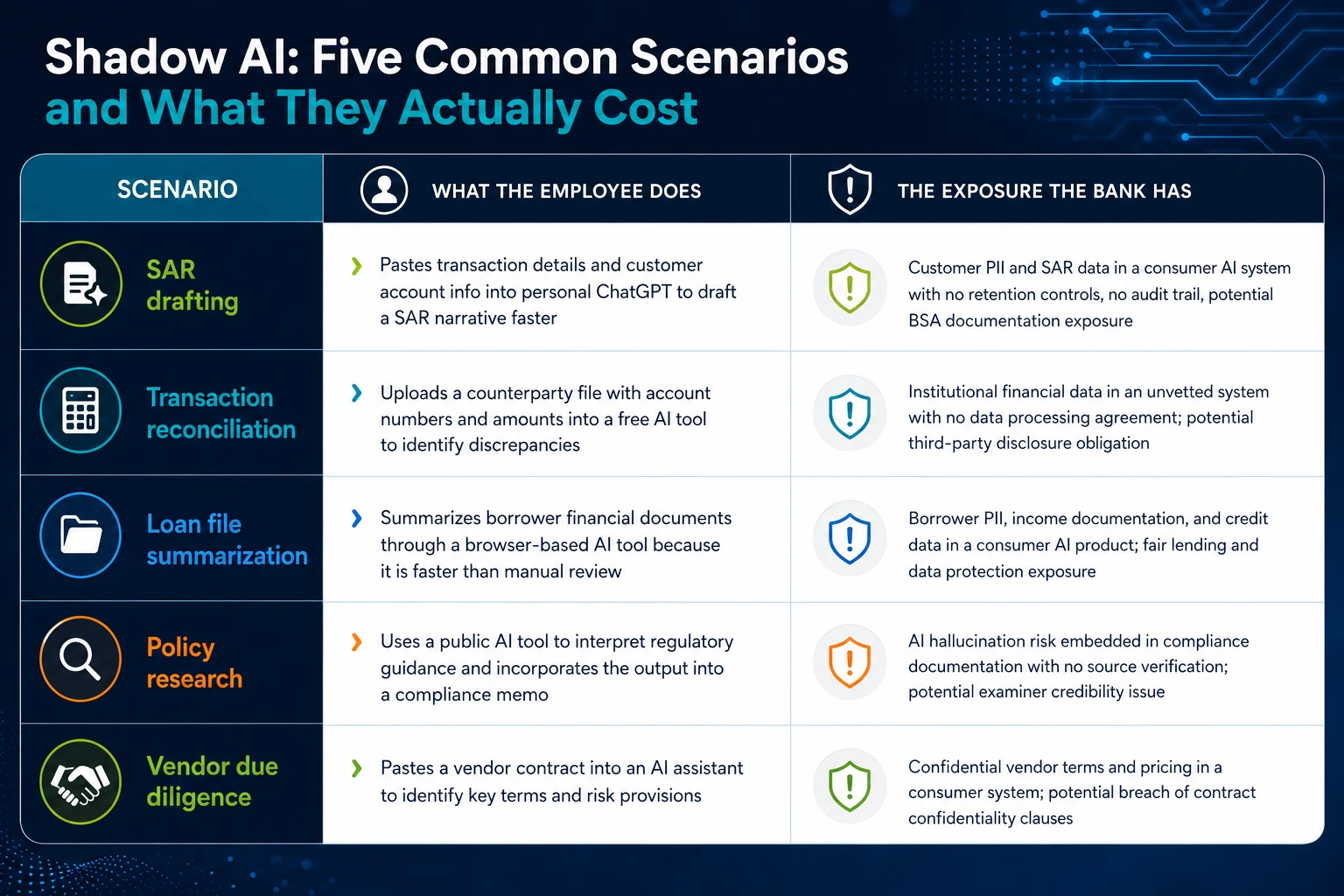
This Is Not a Rogue Employee Problem
The instinctive response is to treat Shadow AI as a training and policy issue: update the acceptable use policy, remind everyone of the rules, move on. The data says this approach does not work.
The PagerDuty 2026 Shadow AI Survey, conducted by Wakefield Research among 1,250 office professionals at companies with revenues above $500 million, found that 66% had used AI tools at work despite believing those tools were not permitted under company policy. This is not a handful of employees bending the rules. It is a majority behavior that policy language alone has not changed.
The reason comes down to a simple math problem. If the approved process for drafting a SAR narrative takes ninety minutes and a personal AI account takes fifteen, the employee who is trying to clear a queue before an examiner deadline will choose fifteen. Every time. A policy that says "do not use unapproved AI" without providing an approved AI that is actually faster than the unapproved one is not a governance solution. It is a compliance document that describes a behavior no one is following.
The institutions that get ahead of Shadow AI are not the ones that ban the fastest. They are the ones that make the sanctioned option the faster option, with the logging, the data controls, the audit trail, and the model governance that examiners expect built in from the start rather than discovered missing during a review.
The Regulatory Blind Spot That Makes This Worse
There is a specific regulatory dimension to Shadow AI in banking that makes the exposure sharper than it is in other industries.
In April 2026, federal banking agencies released updated model risk guidance that explicitly excludes generative and agentic AI from its current scope, with a separate AI-specific framework under development. In plain terms, the exact category of tool your staff is most likely using informally is the category existing model risk frameworks do not yet cover. The bank cannot point to SR 26-2 compliance as evidence that its generative AI use is governed, because SR 26-2 does not govern generative AI. The AIEOG AI Lexicon and the FS AI RMF provide the current framework for addressing that gap, but applying them requires knowing what AI tools are actually in use inside the institution. If Shadow AI use is not visible, it cannot be governed under any framework.
For community banks with BSA and SAR obligations, the data exposure created by Shadow AI is not just a cybersecurity problem. It is a potential BSA documentation problem if AI-generated content makes its way into SAR narratives without disclosure. It is a fair lending problem if AI tools are applied informally in the loan review process without governance or documentation. And it is an examiner credibility problem if the bank cannot answer basic questions about how its staff is using AI in regulated workflows.
What Good Policy Actually Requires
A Shadow AI policy that works has three components that most acceptable use documents currently lack.
1. An AI use case inventory before the policy
Before any institution can write a policy governing AI use, it needs to know what AI is actually being used. That means an anonymous staff survey asking which AI tools employees currently use for work tasks, a review of network logs for traffic to known AI endpoints, and a vendor review for any AI capabilities embedded in existing software products. Most institutions discover in this process that the Shadow AI footprint is larger than anyone expected, and that some of it is already touching regulated workflows. The inventory is the starting point. Policy written without it governs an imaginary problem.
2. A sanctioned alternative that is actually faster
The only policy change that reliably reduces Shadow AI use is providing a governed AI tool that meets the operational need better than the consumer alternative does. This means the governed tool needs to be deployed, accessible, and faster for the workflows where Shadow AI is heaviest. For most community banks and financial services firms, this means a managed AI environment where data stays within the institution's governance boundary, where interactions are logged and auditable, and where the output is subject to the same quality and accuracy standards applied to any other operational process. An AI acceptable use policy with no approved alternative to point to is a policy employees will route around.
3. Ongoing monitoring, not one-time policy
New AI tools launch constantly. Employee behavior adapts. A policy reviewed annually against a tool landscape that changes monthly is not current governance. The institution needs ongoing monitoring of AI tool traffic, periodic re-inventory of what staff are actually using, and a defined process for evaluating and approving new AI tools when employees request them. The institutions that handle Shadow AI well are the ones that made the approval process fast enough that employees use it rather than bypass it.
When an examiner asks to see the documentation behind a compliance decision, the bank needs to produce it. If a compliance analyst used a personal AI account to draft a SAR narrative and the output was incorporated into the final filing, the bank may not be able to produce a complete audit trail of how that narrative was generated. The inability to demonstrate the provenance of compliance documentation is not a minor administrative gap. It is the kind of finding that produces follow-up requests, extended examinations, and in some cases, formal supervisory action. The data that went into an employee's personal AI account is not retrievable by the institution. The output that came back may be inside a regulatory filing.
What This Means for Community Banks and Financial Services Firms
The Shadow AI problem is not going to resolve itself. The Verizon DBIR data shows the behavior tripling in a single year. The PagerDuty survey shows it persisting even among employees who know it violates policy. The regulatory framework for governing it is still being developed. In that environment, the institutions that wait for complete regulatory guidance before taking action on Shadow AI will find themselves explaining unsanctioned AI use in regulated workflows to examiners who arrived before the guidance did.
Three things are worth doing now, regardless of where the institution is on its broader AI strategy.
Conduct an AI use inventory. Survey staff anonymously and review network logs to understand what tools are actually in use. Do not assume the answer based on what has been formally approved. The gap between approved and actual is the Shadow AI footprint.
Establish a board-level position on AI use. Document what is permitted, what requires approval, and what is prohibited. This is the Area 1 authorization boundary from the digital asset governance framework. The same principle applies to AI governance broadly. A bank without a board-adopted AI position has no documented position to defend.
Provide a sanctioned alternative. Identify the workflows where Shadow AI use is heaviest and find or build a governed AI capability for those workflows. The policy conversation becomes substantially easier when there is a faster approved option to point to.
Shore's CORE Assessment evaluates operational readiness across five categories including data readiness and regulatory compliance. For institutions beginning to assess their AI governance posture, it identifies where documentation and infrastructure gaps are concentrated and provides a structured starting point.
Frequently Asked Questions
Is Shadow AI use by employees actually a legal or regulatory violation for the institution?
It depends on what data was involved and which regulatory obligations apply. An employee pasting customer PII into a consumer AI tool may create obligations under the Gramm-Leach-Bliley Act's Safeguards Rule, which requires institutions to maintain appropriate safeguards for customer information, including controls over how it is shared with third parties. For institutions subject to HIPAA, the exposure involves protected health information. For institutions with BSA obligations, AI-generated content in SAR documentation raises provenance and documentation questions that examiners will ask. The institution does not need to find a specific violation to have regulatory exposure. It needs to demonstrate that it has appropriate controls over customer data. Shadow AI use by definition bypasses those controls.
How do we find out what AI tools our employees are actually using?
Three approaches work in combination. An anonymous staff survey asking which AI tools employees currently use for work tasks will surface tools that network monitoring misses, because not all AI access goes through managed corporate devices. A review of network logs and DNS queries for traffic to known AI endpoints (OpenAI, Anthropic, Google Gemini, Perplexity, and others) identifies device-level usage on managed equipment. A review of browser extensions across managed devices will surface AI assistant extensions that operate as a persistent layer on top of other workflows. No single method is complete. Using all three gives the most accurate picture of current Shadow AI exposure.
Does blocking AI websites solve the problem?
No, and it often makes it worse. Employees who cannot access AI tools on managed devices use personal phones or personal laptops to access the same tools with the same data. The block removes visibility without removing behavior. The Verizon 2026 DBIR found that 67% of employees already access AI through non-corporate accounts on corporate devices, which means the behavior is persistent even where blocking is attempted. The more durable solution is providing a sanctioned alternative that meets the operational need.
What should an AI acceptable use policy actually include?
At minimum: a definition of what constitutes AI use for purposes of the policy, a list of approved tools and the workflows they may be used in, a clear statement of what data categories may not be input into any AI tool without specific approval, a process for requesting approval for new tools or use cases, a disclosure requirement for any AI-generated content incorporated into regulatory filings or compliance documentation, and a statement of consequences for policy violations. Vague policies that say "use AI responsibly" or "do not share confidential information" do not change behavior because they do not give employees specific enough guidance to know whether a particular action is permitted. Specificity is what makes a policy operational rather than decorative.
How does Shadow AI relate to the AI governance framework discussed in earlier posts on this blog?
Shadow AI is the governance gap that makes every other AI governance effort harder. A bank can have a sophisticated AI use case inventory and a well-designed risk management framework, and still have regulatory exposure if employees are using unsanctioned tools in regulated workflows outside that framework. The AI use case inventory described in the AIEOG AI Lexicon and FS AI RMF context needs to capture actual AI use, not just formally approved AI use. If the inventory is built only from what IT has approved, it is incomplete before it is published. Shadow AI detection is not a separate program from AI governance. It is a prerequisite for AI governance being accurate.